Node 1 · Feedstock & FabricationNœud 1 · Matières premières & FabricationNó 1 · Matérias-primas & Fabricação
Fogo
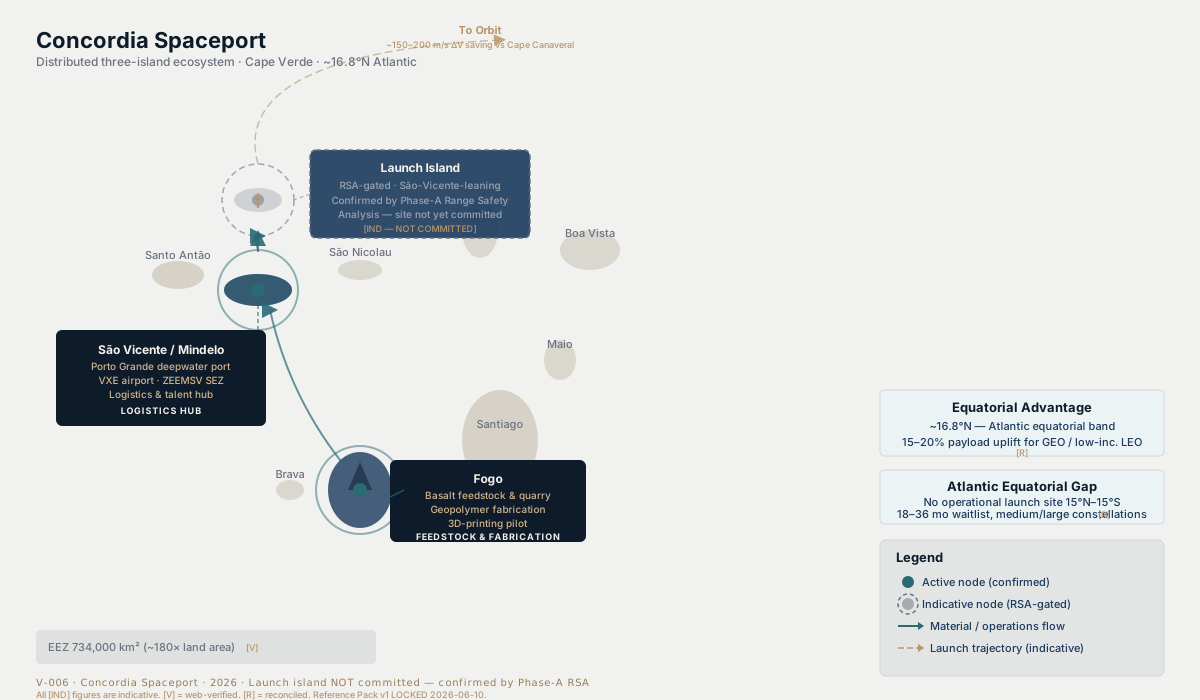
Volcanic basalt quarry, geopolymer binder production, component manufacturing and pre-assembly. Fogo's active-volcano geology makes it uniquely suited to supply ISRU feedstock — and uniquely unsuited to host a launch complex (eruptions 1951, 1995, 2014–15).
Carrière de basalte volcanique, production de liants géopolymères, fabrication de composants et pré-assemblage. La géologie volcanique active de Fogo la rend particulièrement adaptée pour fournir des matières premières ISRU — et particulièrement inadaptée pour accueillir un complexe de lancement (éruptions 1951, 1995, 2014–15).Pedreira de basalto vulcânico, produção de aglutinantes geopoliméricos, fabrico de componentes e pré-montagem. A geologia vulcânica activa de Fogo torna-a particularmente adequada para fornecer matérias-primas ISRU — e particularmente inadequada para acolher um complexo de lançamento (erupções 1951, 1995, 2014–15).
ISRU basalt
Geopolymer
50–80% carbon cut
TRL 3–5 pilot
Node 2 · Logistics & Talent HubNœud 2 · Hub Logistique & TalentNó 2 · Hub Logístico & Talento
São Vicente / MindeloSão Vicente / MindeloSão Vicente / Mindelo
Porto Grande deepwater port, VXE international airport, ZEEMSV Special Economic Zone (Law No. 11/X/2022 class), and Cabo Verde's largest talent cluster. The logistics and staging hub for Concordia Spaceport — components arrive from Fogo, are assembled and cleared, then transported to the launch island.
Port en eaux profondes de Porto Grande, aéroport international VXE, Zone Économique Spéciale ZEEMSV (classe Loi n° 11/X/2022) et plus grand pôle de talents de Cabo Verde. Le hub logistique et de transit pour Concordia Spaceport — les composants arrivent de Fogo, sont assemblés et dédouanés, puis transportés vers l'île de lancement.Porto de águas profundas de Porto Grande, aeroporto internacional VXE, Zona Económica Especial ZEEMSV (classe Lei n.º 11/X/2022) e maior cluster de talentos de Cabo Verde. O hub logístico e de trânsito do Concordia Spaceport — os componentes chegam de Fogo, são montados e desalfandegados, depois transportados para a ilha de lançamento.
Deepwater port
VXE Airport
ZEEMSV SEZ
Talent cluster
Node 3 · Launch ComplexNœud 3 · Complexe de LancementNó 3 · Complexo de Lançamento
RSA-gated — São Vicente-leaningConditionné RSA — orienté São VicenteCondicionado RSA — orientado para São Vicente
The launch pad itself. The specific island is the single open sub-decision in the project, to be resolved by a Phase-A Range Safety Analysis (RSA) and conservation-offset feasibility study. The current lean is toward São Vicente / São Pedro. The regenerative-integrity gate requires siting on degraded, not pristine, land — this is non-negotiable.
Le pas de tir lui-même. L'île spécifique est la seule sous-décision ouverte du projet, à résoudre par une Analyse de Sécurité de Portée (RSA) de Phase A et une étude de faisabilité de compensation de conservation. L'orientation actuelle est vers São Vicente / São Pedro. La porte d'intégrité régénérative impose une implantation sur un terrain dégradé, pas vierge — c'est non négociable.A plataforma de lançamento em si. A ilha específica é a única sub-decisão aberta do projecto, a resolver por uma Análise de Segurança de Alcance (RSA) da Fase A e um estudo de viabilidade de compensação de conservação. A orientação actual é para São Vicente / São Pedro. A porta de integridade regenerativa exige implantação em terreno degradado, não virgem — não é negociável.
Site decision: Phase-A RSA pending
Décision de site : RSA Phase A en attenteDecisão de sítio: RSA Fase A pendente
RSA-gated
Degraded-site only
São Vicente-leaning